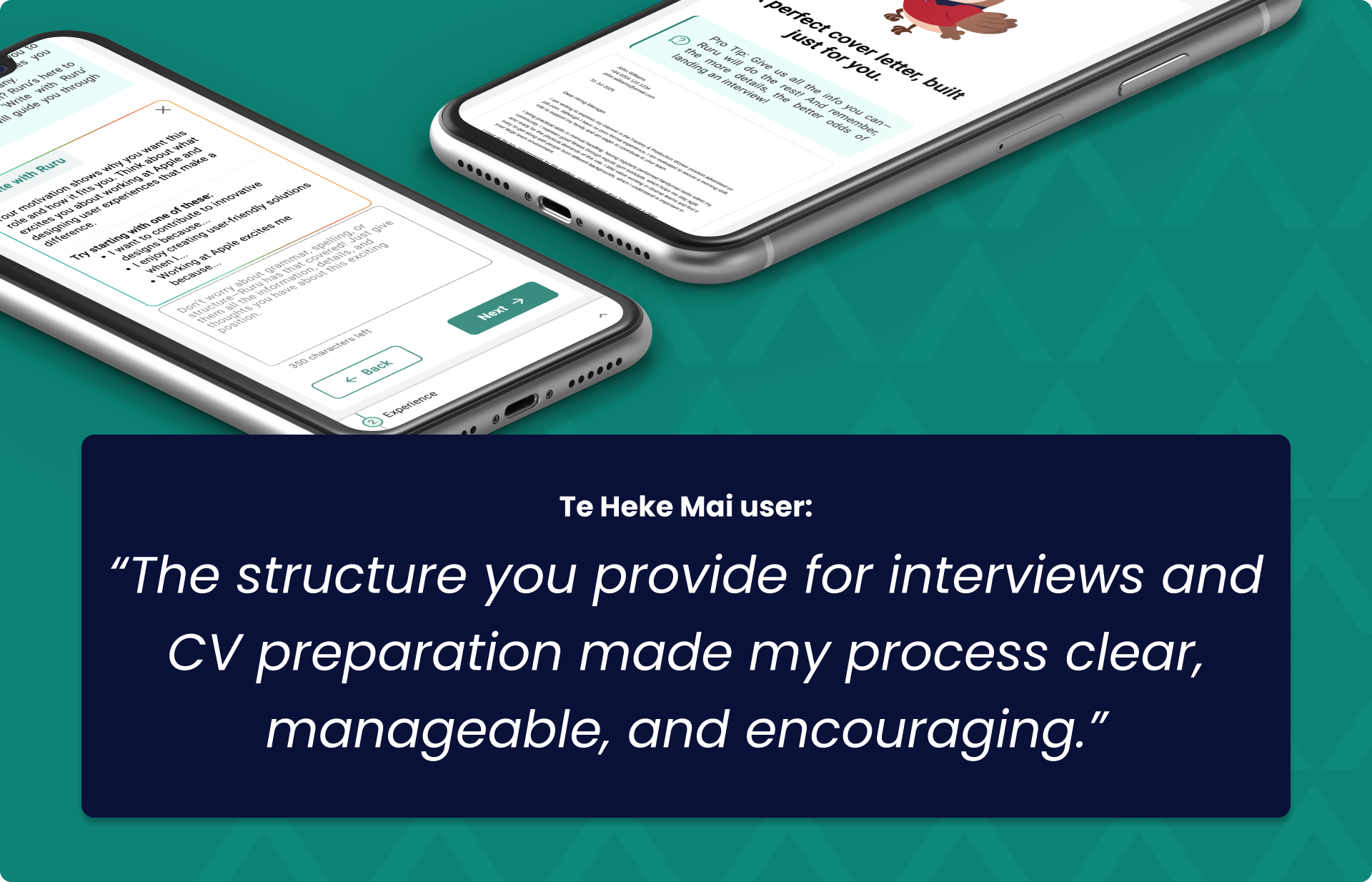
Te Heke Mai
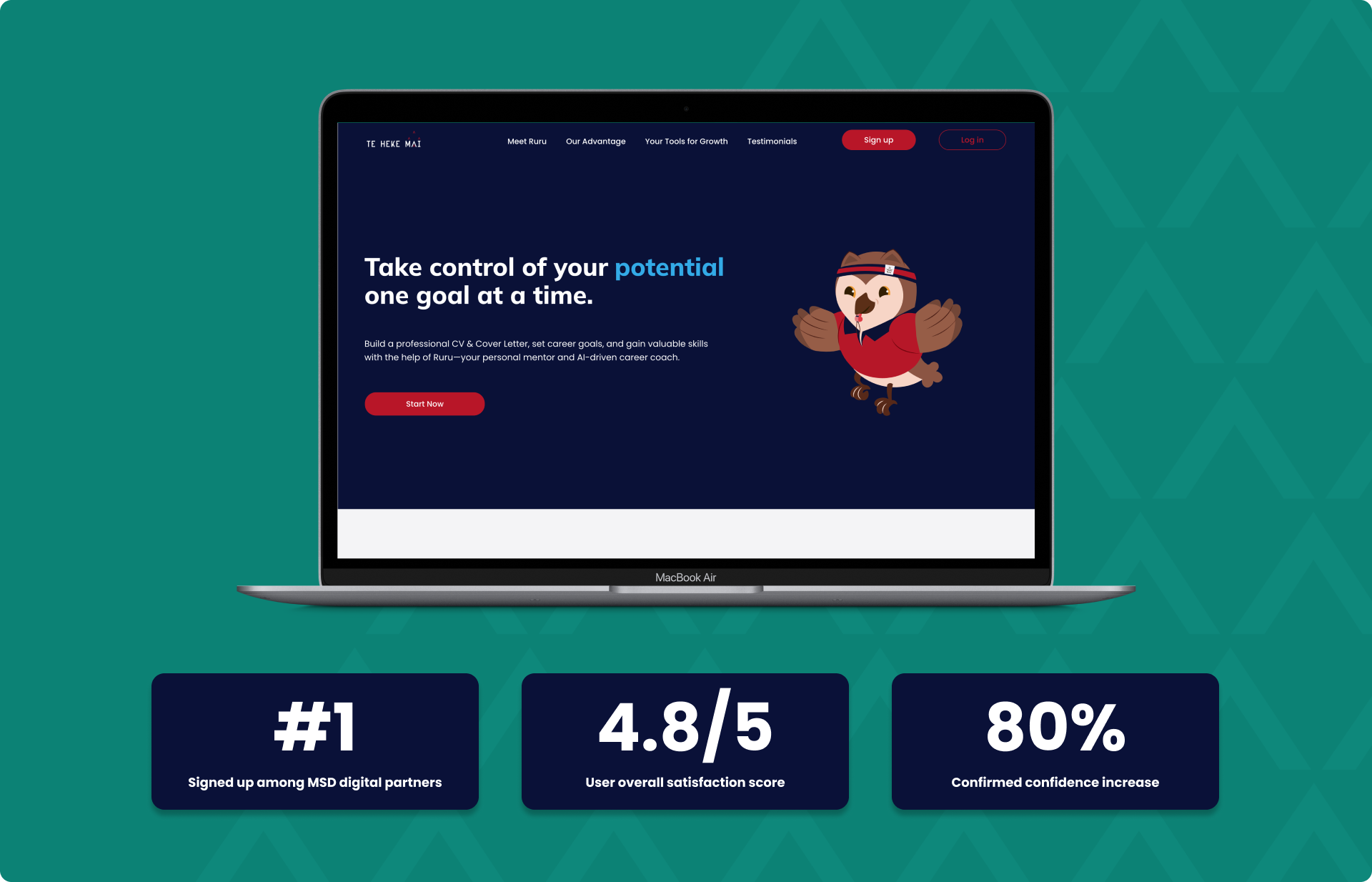
An AI employment platform where 40% of participants moved off a benefit and into work.
Ministry of Social Development, New Zealand · End to end product design and prompt engineering · 16,000+ participants in FY2026 · 40% moved off a main benefit into work, MSD verified
The blank page problem
Job seekers know what they can do. They cannot find the words for it. That gap is where most of them stall, and it is why the Ministry of Social Development wanted a tool in the first place.
I led design end to end on Te Heke Mai and owned the prompt engineering alongside the UX. In FY2026, its first full year at scale, more than 16,000 people signed up, and MSD's own outcomes data showed 40% of participants moving off a main benefit into full or part time work.
Two sides, wanting opposite things
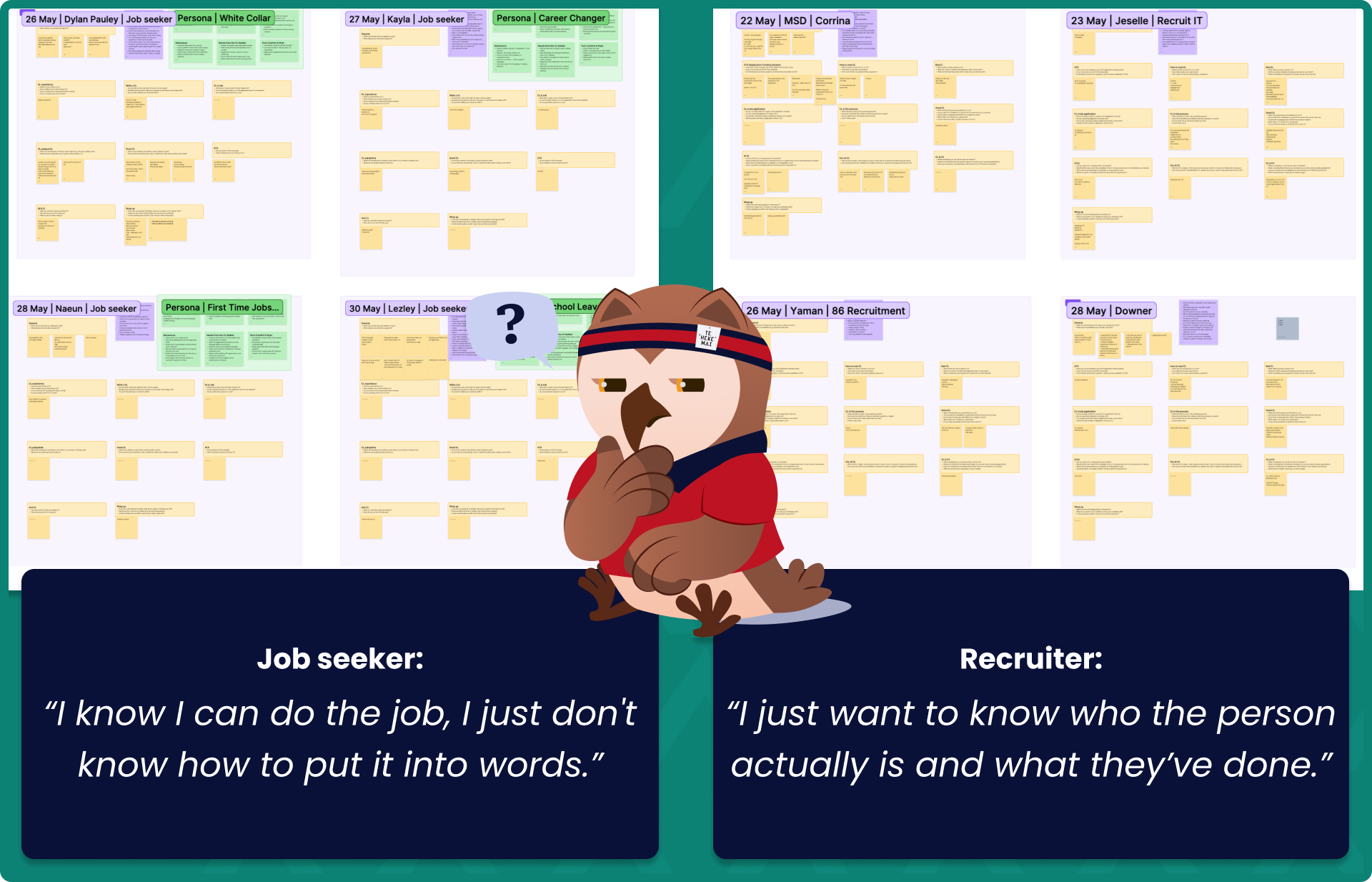
Research insights into the disconnect between user struggles and recruiter expectations across the four stages of recruitment.
Interviews with job seekers and recruiters across the four stages of the recruitment journey turned up a direct conflict. Job seekers wanted the blank page filled. Recruiters were already drowning in generic AI text and had started discounting it on sight.
That reframed the brief. The obvious product, a tool that writes your CV for you, would have made the recruiter problem worse while appearing to solve the job seeker one. So the target changed from generating text to acting as a bridge: getting the person's real story out of them, in their own words, in a form a recruiter would trust.
The evidence that it worked is not a satisfaction score. Of the 5,105 cover letters written on the platform last year, 76% were written against a specific job advertisement and 78% were linked to a CV built on the same platform. People were tailoring, which is the behaviour the whole thing was designed to produce and the one job seekers almost never sustain on their own.
Ruru, and the chat box I did not build
Providing contextual support across the user journey without the chat-box fatigue.
The default answer in 2024 was a chat window in the corner. I decided against it. A chat box asks the user to know what to ask, and these were people at a low point, 42% of them aged 16 to 24, many facing digital literacy barriers. Putting a blinking cursor in front of them recreates the blank page in a new font.
So Ruru lives inside the journey instead, appearing at the moment of need rather than waiting to be summoned.
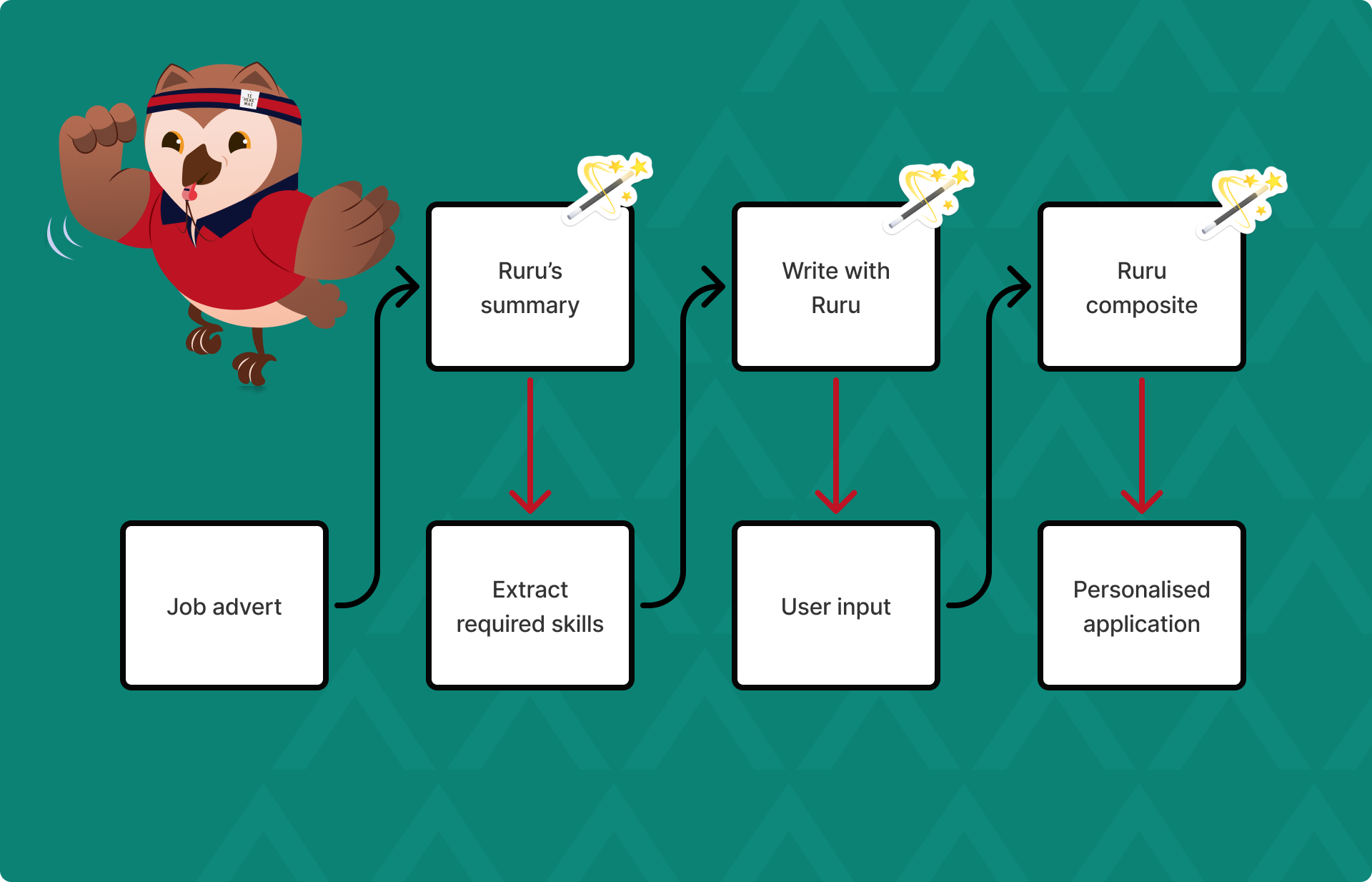
Ruru's Summary
Turns a dense job advert or an interview invitation into plain language.
Write with Ruru
Guides a CV, cover letter or application response, anchored to the user's own story rather than to a template.
Ruru's Feedback
Reacts to interview answers without judgement, on both what was said and how.

Prompt engineering was the design work
Applying UX principles to AI logic, so user intent stays at the heart of the experience.
I wrote the system prompts myself, because on this product they were not an implementation detail. They were where tone, context and trust actually got decided, and handing that over would have meant handing over the experience.
The design problem was that good output needs good input, and no user should have to learn prompting to get it. So Ruru asks instead of waiting. It runs a structured interview, pulls out the specific detail that makes an answer sound like a person, and carries the logic invisibly behind the conversation. The user answers questions about their own life. The system does the rest.
One rule held the whole thing together: the AI organises, it never invents. Everything in a finished CV came out of the participant's own mouth. That is what made the output survive contact with a recruiter, and it is the constraint most AI writing tools refuse to accept.
Closing the loop, one capability at a time
An all-in-one platform that replaces fragmented tools with a single, seamless journey.
Job seekers were running their search across a job board, a word processor, a notes app and their memory. Every handoff was a place to lose momentum, and momentum is most of what a long search runs on.
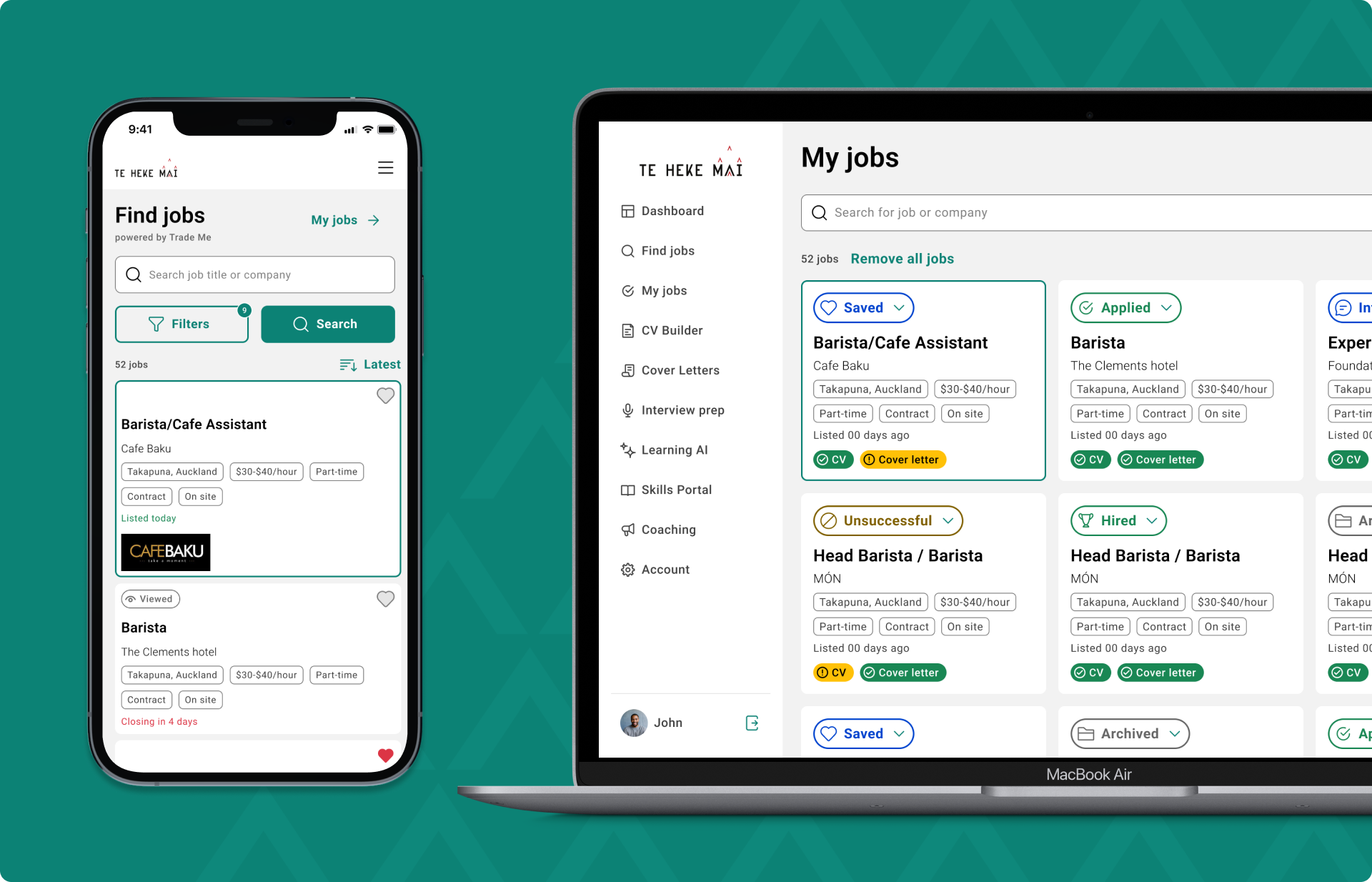
We closed that loop one piece at a time across eighteen months: the AI CV Builder in March 2025, the Cover Letter Builder that July, Find Jobs with a live TradeMe integration in December, and Interview Prep in June 2026. Each one removed a step where people used to drop out. By May, Find Jobs held over 3,000 live roles and was converting views to applications at 10.7%.
The pattern in the data was consistent: return rate ran between 62% and 68% across the year, peaking at 68%. In the programme's own analysis it is the strongest single predictor of whether someone finds work. People who come back use the tools, and people who use the tools get jobs.
What it did
Delivering meaningful outcomes through human-centric AI design.
Te Heke Mai redefined the job-seeking experience for Ministry of Social Development clients by turning AI into a supportive career coach. The clearest evidence it worked is not a satisfaction score, it is what happened to the people who used it.
These outcomes come from MSD's own data for the FY2026 referred cohort, measured in MSD's framework rather than ours.
Of participants moved off a main benefit into full or part time work.
Māori participation, against the 30 to 35% typical of comparable MSD employment programmes.
New participants in the platform's first full year at scale.
The number I keep coming back to is the 43%. It is the one that proves the design worked for the people standard tools cannot reach, and reach into hard to serve cohorts is the entire reason this platform exists rather than a generic job board. Employment outcomes are what a programme is judged on. That one is what it is for.